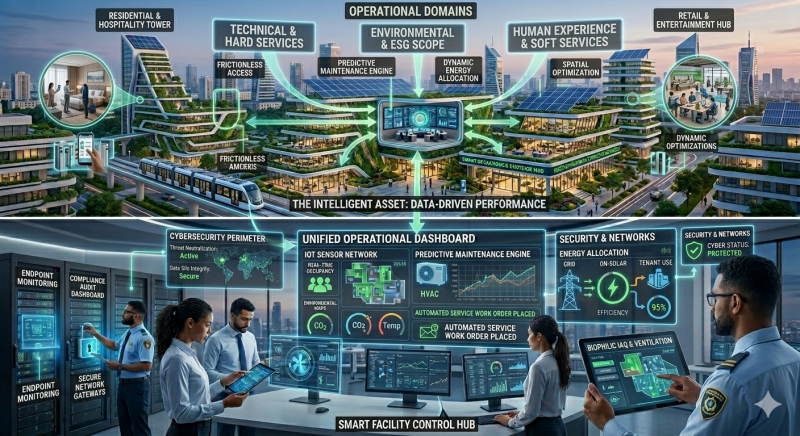
As real estate assets evolve into complex, data-driven ecosystems, defining the boundaries of building operations has become crucial. It is no longer enough to state what smart facility management is; organizations must understand where and how it applies. The smart facility management operational scope delineates the entire spectrum of digital, physical, and human elements that modern facility managers oversee to keep an infrastructure resilient, safe, and efficient.
From automated plant machinery to digital tenant experiences, mapping this operational scope is the blueprint for executing a successful corporate real estate strategy.
Defining the Scope: The Multi-Layered Ecosystem
Unlike traditional facility management which operates in isolated physical silos, the operational scope of Smart Facility Management (SFM) is interconnected. It blends physical assets, digital networks, and human interactions into one unified management layer, often monitored through a centralized control hub.
The scope is divided into four primary domains:
1. Technical and Hard Services Operations
This is the physical backbone of the facility, completely augmented by automated data streams.
-
Predictive HVAC & Climate Control: Continuous tracking of air handling units, chillers, and boilers to optimize airflow and temperature based on real-time occupancy.
-
Smart Lighting Networks: Managing automated LED grids that adjust illumination based on natural daylight availability and workspace traffic.
-
Elevator & Vertical Transportation Maintenance: Monitoring micro-vibrations and engine load cycles to predict mechanical failures before they cause floor-to-floor disruptions.
2. Environmental and Sustainability Management (ESG Scope)
Modern SFM carries the heavy responsibility of achieving corporate net-zero targets.
-
Dynamic Energy Allocation: Managing the intelligent grid that balances power consumption between traditional municipal grids and on-site renewables like solar panels or wind storage.
-
Biophilic IAQ & Ventilation Control: Automated management of carbon dioxide (CO2) and particulate levels to ensure clean indoor environments while minimizing energy waste.
-
Water & Waste Analytics: Tracking automated graywater filtration systems, leakage detection networks, and AI-powered waste compactor metrics.
3. Human Experience and Soft Services Operations
The operational scope extends directly to the comfort, health, and productivity of the building’s occupants.
-
Frictionless Workplace Access: Overseeing touchless security gates, automated visitor management systems, and smart parking operations.
-
Spatial Optimization: Utilizing IoT sensor networks to track floor-space utilization, allowing managers to dynamically reconfigure office layouts or close down unpopulated sectors to save costs.
4. Cybersecurity and Network Infrastructure
Because an SFM ecosystem relies heavily on the Internet of Things (IoT), securing the digital perimeter is now a core part of the facility manager’s daily scope.
-
Data Silo Protection: Ensuring firewall isolation between critical operational systems (like power grids or access control) and standard corporate IT networks.
-
Endpoint Monitoring: Continuous compliance audits of thousands of connected IoT sensors to neutralize cyber vulnerabilities.
Traditional vs. Smart FM Operational Scope
Expanding the boundaries of facility management transforms everyday operations from localized fixes to macro-level portfolio strategies:
| Operational Dimension | Traditional FM Scope | Smart FM Operational Scope |
| Asset Monitoring | Localized manual inspections, clipboard logs | Continuous IoT data streaming, unified cloud dashboards |
| Maintenance Trigger | Calendar dates or equipment failure | Condition-based predictive machine engines |
| Energy Policy | Static operational hours (e.g., On at 8 AM) | Dynamic, AI-driven automation based on real-time demand |
| Security Responsibility | Physical guards, isolated CCTV loops | Integrated physical access systems & cybersecurity protocol |
The Strategic Importance of a Well-Defined SFM Scope
Clearly outlining the smart facility management operational scope offers direct advantages to real estate investors and corporate leadership:
-
Elimination of Operational Blindsports: Unifying technical, environmental, and digital assets under one scope removes data silos, preventing conflicting system operations (such as heating and cooling fighting each other in the same zone).
-
Optimized Operational Expenditure (OpEx): Knowing the exact scope allows leadership to allocate capital effectively—investing in predictive software integrations where they yield the highest energy and labor ROI.
-
Future-Proof Scale: A modular, well-mapped operational scope allows companies to seamlessly plug in new technologies (like drone inspections or advanced robotics) as the property grows.
Conclusion: The New Horizons of Facility Operations
The smart facility management operational scope proves that modern building management is no longer a localized maintenance job. It is a highly sophisticated, multi-disciplinary orchestration of physical hardware, cloud software, and environmental science.
By comprehensively managing every layer of this expanded scope, forward-thinking organizations ensure their real estate assets remain highly efficient, completely compliant, and safe for both the workforce and the environment.