The traditional role of managing buildings has officially outgrown the era of clipboards, manual spreadsheets, and reactive repairs. As properties grow more complex and connected, a new standard has emerged. But what exactly is the smart facility management definition, and how is it reshaping the landscape of modern real estate?
At its core, smart facility management (SFM) represents the integration of advanced digital technologies into daily building operations to maximize efficiency, enhance tenant comfort, and drastically reduce environmental impact.
In this comprehensive guide, we will break down the precise definition of smart facility management, its core technological pillars, and why it is essential for the future of building operations.
Defining Smart Facility Management (SFM)
Smart Facility Management Definition: It is a data-driven approach to operating and maintaining the built environment using an interconnected ecosystem of Internet of Things (IoT) sensors, Artificial Intelligence (AI), and cloud-based software. Unlike traditional management, SFM continuously collects, analyzes, and acts upon real-time data to automate building processes and predict maintenance needs before failures occur.
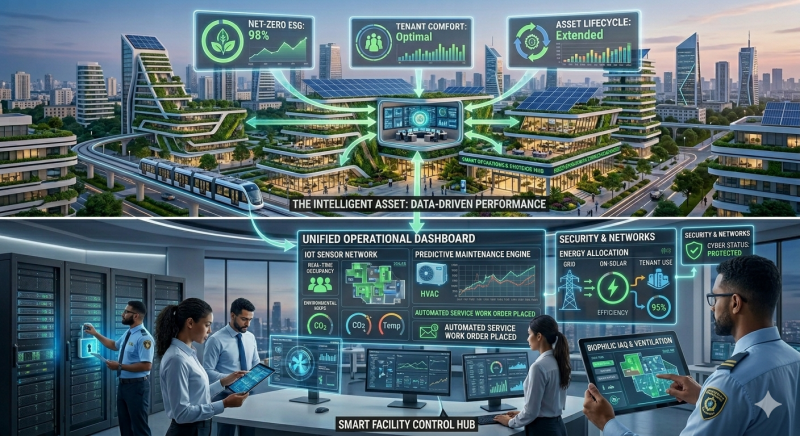
Instead of treating a building as a collection of isolated systems (heating, lighting, security), SFM unifies these elements into a single, cohesive, and intelligent infrastructure—often monitored from a centralized command center, as visualized in next-generation operational hubs.
The Core Technological Pillars of SFM
To fully grasp the definition, one must understand the three technology layers that make a facility “smart”:
1. The Internet of Things (IoT) & Data Collection
IoT sensors act as the nervous system of the building. They are strategically placed throughout the facility to monitor variables such as:
-
Occupancy & Space Utilization: Tracking which desks, floors, or meeting rooms are actually in use.
-
Environmental Metrics: Real-time auditing of Indoor Air Quality (IAQ), temperature, and humidity.
-
Resource Consumption: Smart meters tracking precise water and electrical usage.
2. Artificial Intelligence & Predictive Engines
Data is useless without interpretation. AI and machine learning algorithms act as the brain, processing thousands of data points to:
-
Predict Component Failures: Spotting micro-vibrations in an HVAC chiller to alert engineers 48 hours before it breaks.
-
Automate Energy Allocation: Dynamically shifting energy loads between the traditional grid and on-site solar storage based on weather forecasts and occupancy trends.
3. Integrated Software (IWMS & CAFM)
The user interface. An Integrated Workplace Management System (IWMS) or Computer-Aided Facility Management (CAFM) platform aggregates all data onto intuitive dashboards, allowing managers to oversee asset lifecycles, compliance, and cyber-vulnerability status seamlessly.
Traditional vs. Smart Facility Management: The Structural Shift
Understanding the practical definition of smart facility management is easiest when comparing it to traditional, legacy methods:
| Feature / Metric | Traditional Facility Management | Smart Facility Management |
| Operational Stance | Reactive (Fixing problems post-failure) | Predictive & Proactive (Preventing issues) |
| System Visibility | Siloed (Separate teams for HVAC, IT, Security) | Unified (All systems synced on one dashboard) |
| Energy Strategy | Static timers (Lights/AC on 9 AM – 5 PM) | Dynamic Automation (Occupancy-based tracking) |
| Asset Maintenance | Calendar-based (Service every 6 months) | Condition-based (Service when data indicates wear) |
Why Is This Definition Essential for Modern Real Estate?
The transition to a smart facility management model directly solves the most pressing macroeconomic challenges facing property owners today:
-
Drastic Cost Reductions: By eliminating energy waste and avoiding catastrophic equipment failures, SFM slashes operational expenses (OpEx) by up to 30%.
-
Seamless ESG Compliance: SFM platforms provide the precise, auditable carbon tracking data required to meet strict net-zero and green energy mandates.
-
Elevated Tenant Retention: From optimal ventilation control to seamless mobile-app access, smart facilities provide the premium, healthy, and frictionless workplace experiences that modern corporate tenants demand.
Conclusion: A Strategic Business Asset
Ultimately, the smart facility management definition extends far beyond simple automation. It represents a fundamental shift in how corporations view physical real estate. A smart facility is no longer just a passive shell where work happens; it is an active, self-optimizing strategic asset that protects bottom lines, extends building lifecycles, and safeguards human health and the environment.